
Master Key Systems for Small Businesses
Luckey Lock · April 7, 2026 · 8 min read
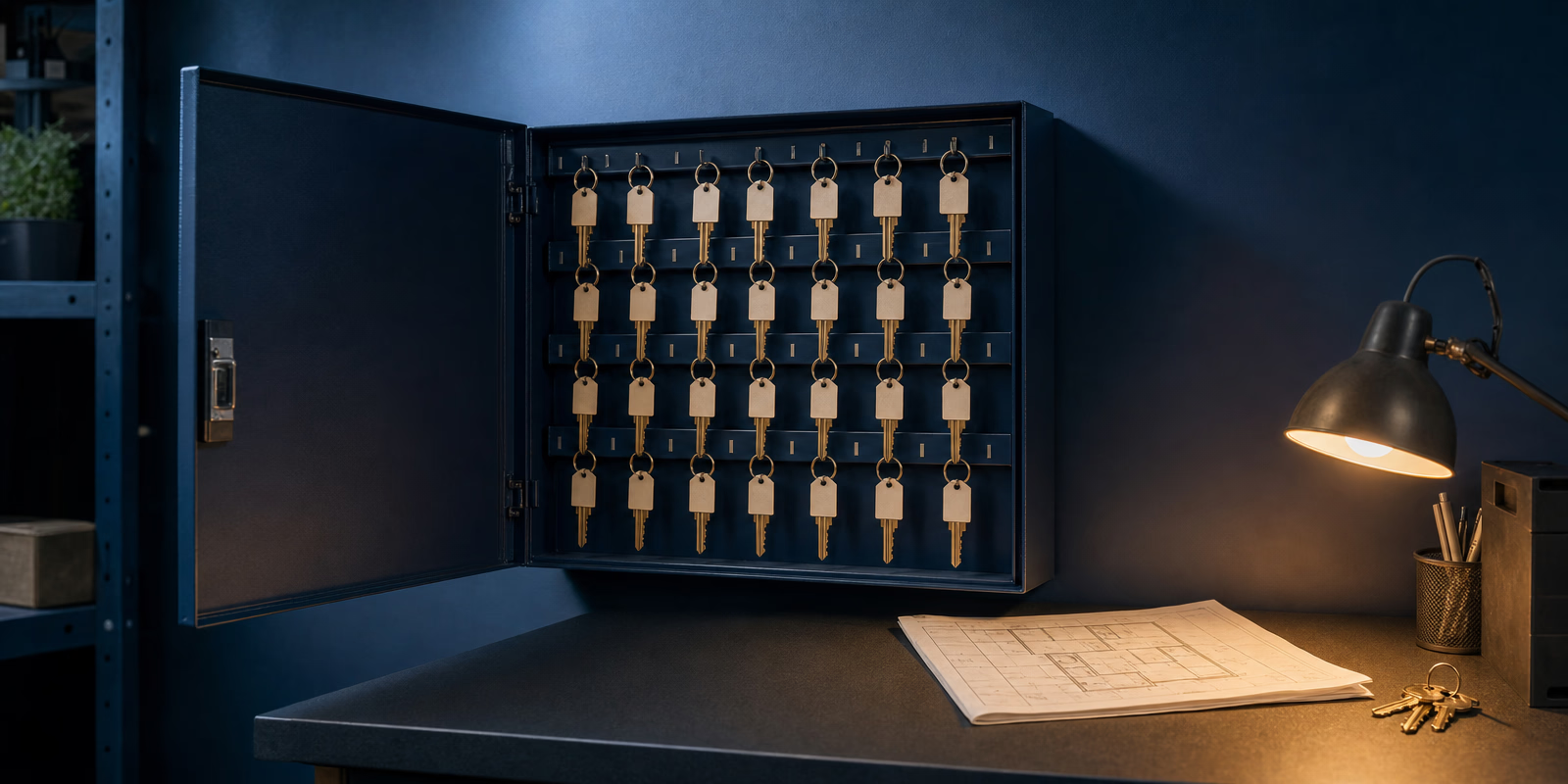
There is a stage every growing business reaches where the keys stop making sense. The owner carries a ring with nine of them and can identify four. The evening supervisor has a key to the back door but not the stockroom, so somebody props the stockroom open. A key went home with an employee in February and nobody wants to raise it. Everyone is working around the key system instead of using it.
A master key system is the fix. It is an old idea, it is not glamorous, and it solves this problem better than anything else at the price.
In a master key system, every lock is cut so that it accepts more than one key: the key belonging to that specific door, and one or more higher level keys that open a group of doors. A lock cylinder can be built to respond to several different key cuts, which is what makes the hierarchy possible.
The usual levels, from the bottom up:
The practical result is that the owner carries one key instead of nine, the evening supervisor carries one key that opens exactly what the role requires, and the summer student carries one key that opens the one door they need. Nobody props anything open, because nobody is fighting the system.
This is the part people underestimate. The cutting is straightforward. The design is where a system succeeds or fails, and it is a planning exercise about roles rather than about locks.
Work through these before the locksmith touches a cylinder:
A system designed too tightly cannot grow
The mathematics of a master key system is finite. Every additional key level and every additional door consumes part of a limited set of possible combinations. A system laid out with no headroom will eventually reach a point where the next door cannot be added without compromising the design, and the answer at that point is to rebuild it from scratch. Telling the locksmith your five year plan at the design stage costs nothing and prevents that.
A master key system built on ordinary hardware store blanks has a soft spot: anybody holding a key can walk into a shop and have a copy cut. On a system where one key opens the whole building, that is a serious gap.
A restricted or patented keyway closes it. The blanks are only supplied to authorized locksmiths, and copies are only cut for people on the system's authorization list that you control. A departing employee cannot quietly make a spare, and a key handed to a contractor cannot multiply. It costs more per key, and for any system where a master key exists it is usually the right call. We cover the mechanics of restricted blanks in our piece on how key cutting works.
Every master key system needs two documents that live somewhere other than a drawer in the back office. The first is the keying schedule, which records which key level opens which door. The second is the key issue log, which records who holds which key, when it was issued, and when it came back.
Without the second one, you cannot answer the only question that ever matters in a security incident, which is who could have been in that room. And it degrades quietly. A system installed properly and logged for six months, then left alone for three years of staff turnover, is no longer a system. It is a pile of keys with a diagram nobody trusts.
A workable key issue log.
| Field | Why it is there |
|---|---|
| Key stamp or serial number | Identifies the physical key, so a returned key can be matched to the record. |
| Key level | Change, sub-master, or master, so you know the exposure at a glance. |
| Holder name and role | The person, plus the role that justified the access. |
| Date issued and signature | Establishes that the holder accepted responsibility for it. |
| Date returned | The field that makes an exit checklist enforceable. |
This is the risk you accept in exchange for the convenience, and it is worth being clear-eyed about it. A lost change key affects one door. A lost master key affects every door in the system, and the honest answer is usually to rekey the whole system, which is a real expense.
Sensible ways to limit that exposure:
Fair question, and the answer is often both. Mechanical master keying is inexpensive per door, needs no power, no wiring, and no network, and it keeps working during an outage. Electronic access control gives you an audit trail, credentials you can revoke instantly, and schedules, at a higher cost per door and with an ongoing maintenance load.
A common arrangement for a small business is electronic control on the main entrances, where turnover and after-hours access matter most, and mechanical master keying everywhere behind them. Our article on access control basics compares the credential types, and our commercial locksmith service covers both sides.
The design conversation is usually the longest part, because it is about roles and access boundaries rather than hardware. Once the schedule is agreed, rekeying the existing cylinders and cutting the keys is normally a short piece of work for a small business.
Often yes, if the cylinders are a compatible type and in sound condition. Where hardware is worn, damaged, or of an incompatible design, those doors need new cylinders. A locksmith can tell you which of your doors fall into which category on a walkthrough.
A change key affects only their door and is inexpensive to rekey. A master key is a different matter and usually means rekeying the system. That difference is the argument for issuing very few master keys and using a restricted keyway.
For any system with a master key, generally yes. Restricted blanks are supplied only to authorized locksmiths and cut only for people on your authorization list, which stops unauthorized spares from circulating quietly.
If your key ring has stopped making sense, call (587) 966-5625. We will walk the site with you, map the doors against the roles, and design a system that still fits when the business is bigger. Firm quote before any work begins.
Ready to sort out your business keys?
Call (587) 966-5625 for master key design, restricted keyways, and commercial rekeying across Calgary.
Get a quoteAbout Luckey Lock
Luckey Lock
Luckey Lock is a locksmith serving Calgary, Alberta, available 24 hours a day, 7 days a week. Our locksmiths work out of fully equipped vans, so most automotive, residential, and commercial work is finished on site. Luckey Lock is owned and operated by Ido Shlomovich, an Alberta Certified Journeyperson in the locksmith trade, Certificate 244189A, issued under the Skilled Trades and Apprenticeship Education Act.
A plain comparison of keys, keypad codes, fobs and cards, and phone credentials for a small business, plus the questions to settle before you buy.
How a blank becomes a working key, what happens when there is no original, and why a modern car key needs more than a cut blade to start the engine.
What landlords and short-term hosts should know about locks between guests and tenants: rekeying, codes, key control, and the Alberta rules to check first.